Oct 6, 2026Certifications & Compliance
How to Verify a Chinese Tea Supplier's Certificates
A buyer's checklist for verifying a Chinese tea supplier: ISO 22000, FDA registration, halal GSO 2055-1 and GI marks.
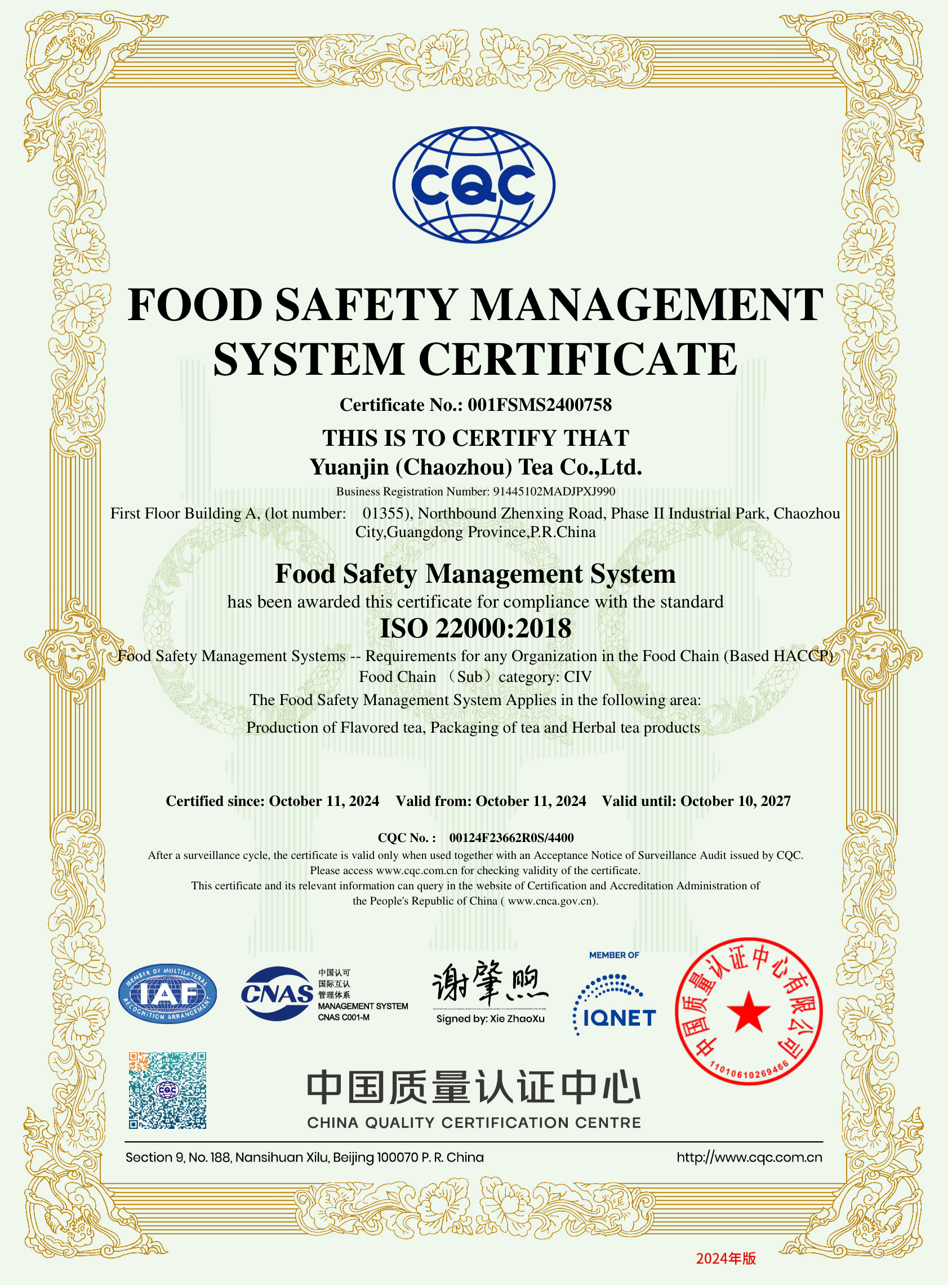
When a Chinese tea supplier sends over a folder of certificates, the folder proves nothing by itself. Certificates can be expired, scoped for different products, or issued to a different facility entirely. Verification is the buyer's job, and it is easier than most buyers assume, because every document that matters carries a number you can check. Here is the checklist we recommend, illustrated with our own documents, each of which is verifiable today.
The Four Documents That Matter Most
For most tea import programs, four documents carry the weight: an ISO 22000 food safety management certificate for the factory; an FDA facility registration if tea is headed to the United States; halal certification against GSO 2055-1 for Middle East programs; and a Geographical Indication mark when you are buying an origin-protected tea such as Phoenix Dancong. Ask for all four up front, original copies rather than screenshots, and check each one the same way: number, scope, validity, issuer.
Verify the ISO 22000 Certificate
Our ISO 22000:2018 certificate is issued by CQC, one of China's major certification bodies, under number 001FSMS2400758. It has been in force since 11 October 2024 and runs until 10 October 2027. The scope matters as much as the number: it covers the production of flavored tea and the packaging of tea and herbal tea products, which is the scope a tea buyer actually needs.
Your verification steps: confirm the certificate number resolves through the issuing body; check that the validity dates are current; and read the scope line to confirm it covers your products. A flawless certificate scoped for the wrong product category is a rejection, not a pass. Then pair the document with evidence that the system runs daily: our line includes color sorting at about 1,000 kg per hour, electrostatic and magnetic impurity removal, foreign-object detection down to 0.1 mm, and a 1,000-ton constant temperature and humidity warehouse.
Verify the FDA Facility Registration
For US programs, ask for the facility's FDA registration number and DUNS number. Ours are registration no. 10319209992 and DUNS 450984434, valid through 31 December 2026. Check that the numbers match across documents, confirm the registration is current, and have your customs broker confirm it clears FDA screening when entries are filed.
While you verify, keep the language precise, because overclaiming cuts both ways. FDA facility registration is a notification, not a product approval; any supplier who describes it as FDA approval is either confused or selling. The registration confirms the facility is registered with the US FDA, and your own importer verification duties under FSVP sit on top of it.
Verify Halal Certification for Middle East Programs
Our halal certification is issued by Shandong Halal Certification Service (SHC) against GSO 2055-1:2015, the Gulf standard for halal products, general requirements, and is valid for the Middle East market. Verification follows the same discipline: request the original certificate, check the number through the issuing body or a public verification service such as ehalal.cn, and confirm the certified scope covers flavored and scented teas if those are in your order. Public halal verification services such as ehalal.cn also list certified holders and are worth a cross-check.
This is the document a Gulf distributor asks for first, and it is also where scope mismatches appear most often, so read it line by line before it reaches your customer's compliance team.
Check the GI Mark on Origin Teas
If you are buying Phoenix Dancong, the name itself is protected. Phoenix Dancong Tea carries the China Geographical Indication protected product mark, recorded under certificate no. 9245102MADJPXJ99Q and announcement 2025 No. 660. GI records are published by the Chinese authorities, so the announcement can be checked, and the mark should appear consistently across a genuine origin supplier's documentation. Our Chaozhou plant sits adjacent to Phoenix Mountain and ranks No. 1 in Phoenix Dancong output in Chaozhou, which is the kind of origin claim a GI-backed file should be able to support.
Red Flags in Any Certificate Review
Some patterns should slow a conversation down. The supplier will not share originals. The scope line does not match your products. The validity dates have lapsed. The certificate number does not resolve anywhere. The company name on the certificate differs from the entity on the contract without explanation. Each is survivable alone; together they end negotiations.
One structural check matters more than any single document: the certified entity should be the manufacturing entity. Certificates belonging to a trading company do not cover the factory where your tea is actually made, and auditors in your supply chain will find that gap before you do.
Request Our Complete Documentation File
We keep the file ready: the CQC-issued ISO 22000 certificate, FDA facility registration, halal certification against GSO 2055-1:2015, China export food producer registration and GI documentation for Phoenix Dancong. Send your destination market and target categories through the contact form on our website or on WhatsApp at +86 130 7163 2772. Our export team replies to every inquiry with the documents and profile sheets for your compliance file.